
Asphalt & Architectural Shingle Inspection — Crown Eagle Restoration

Crown Eagle Restoration — Asphalt & Architectural Shingles
Asphalt shingle hail damage is the most common — and the most commonly underdocumented.
Granule loss, bruising, and fractures are frequently missed or underestimated without close-up photography. Crown Eagle Restoration documents relevant visible and safely accessible conditions with close-up photographs and written notes, included in the complimentary written condition report.
The Asphalt Shingle Reality
The most common roofing material in South Denver is also the most frequently misassessed after hail.
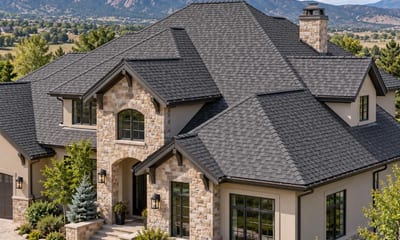
Architectural and triple-laminate asphalt shingles are the most common roofing material on estate homes in South Denver, Highlands Ranch, and Castle Pines. Surface damage on asphalt shingles is real, documentable, and easy to underestimate without close-up photography.
Crown Eagle Restoration documents asphalt shingle hail damage with the same rigor we apply to tile and wood shake: close-up photography of every affected shingle, written location notes, and a condition report that gives you an independent record. We serve estate homeowners across South Denver, Castle Pines, Highlands Ranch, Greenwood Village, and Centennial.
"Granule loss from hail is not cosmetic. It is the beginning of accelerated shingle aging that shortens the roof's service life by years."
What We Document
Six conditions that determine the true state of your asphalt shingle roof.
Hail Bruising
Hail impact on asphalt shingles creates a circular bruise — a soft spot where the mat beneath the granule layer has been fractured. Bruises are visible as dark circular marks and are soft to the touch. They are the primary indicator of functional hail damage on asphalt shingles.
Granule Loss
Each hail impact displaces granules from the shingle surface, exposing the asphalt mat to UV degradation. Granule loss from hail is concentrated at the impact point and creates a circular bare spot. Uniform granule loss across the shingle is normal aging; circular bare spots are hail damage.
Shingle Fractures
Severe hail impacts can fracture the shingle mat entirely, creating cracks or splits that allow water infiltration. Fractures are most common on older shingles where the mat has become brittle, but can occur on any shingle with hailstones of 2 inches or larger.
Seal Strip Failure
The adhesive seal strip on the underside of each shingle holds it flat against the roof. Hail impact can break the seal, allowing shingles to lift in wind and creating pathways for water infiltration. We inspect seal strip integrity as part of every asphalt shingle assessment.
Ridge Cap Damage
Ridge cap shingles take the most direct impact on an asphalt shingle roof. We check ridge caps for bruising, granule loss, and fractures — conditions that are often the first to fail.
Flashing & Valley Condition
Metal flashings and valley liners are frequent failure points on asphalt shingle roofs. We inspect every flashing for corrosion, separation, and improper sealing — conditions that cause water damage independent of the shingle condition and are often overlooked in standard inspections.
The Documentation Standard
What close-up documentation shows.
Storm damage on asphalt shingles tends to follow a pattern: circular bruises with granule loss at the impact point, spread across the roof in a density and direction consistent with the storm. A few scattered granule-loss spots usually mean something different from a documented pattern across multiple slopes with mat fractures and seal-strip failure.
Crown Eagle Restoration documents impact density, distribution, and the specific conditions at each affected shingle, so you can see the pattern for yourself.
It is documentation of what is actually present, produced before any work is proposed. Findings are included in the complimentary written condition report — no restoration agreement required.

Class 4 Impact-Resistant Shingles
After a hail event, the replacement conversation often includes an upgrade opportunity.
Class 4 impact-resistant asphalt shingles — rated under UL 2218, the highest impact resistance classification — are significantly more resistant to hail damage than standard architectural shingles. Many Colorado homeowner's insurance policies offer premium discounts of 20 to 30 percent for homes with Class 4 roofing.
When a full replacement is warranted, Crown Eagle Restoration discusses Class 4 options as part of the replacement conversation. The premium over standard architectural shingles is typically modest, and the insurance discount often offsets the cost difference over the policy term.
The first step is always a condition assessment. We document what is actually damaged before any replacement conversation begins — and we explain the Class 4 option only when replacement is genuinely warranted.
The Inspection Process
Documentation first. Decisions second.
Every Crown Eagle asphalt shingle inspection begins with a ground-level assessment, followed by a close-up inspection of every accessible shingle surface. We photograph each bruise, granule-loss spot, and fracture with close-up photography that makes the damage visible in the written condition report.
We also inspect the ridge caps, flashings, valleys, and gutters — the full exterior system, not just the shingle field. Damage to these components is frequently missed in standard inspections and can cause water damage independent of the shingle condition.
Our documentation includes a summary of findings, photographs of each documented condition, and a plain-language explanation of what each condition means for the roof's service life. Findings are included in the complimentary written condition report — no restoration agreement required.

Preserve.
When the system is sound
An asphalt shingle roof with isolated damage, intact seal strips, and sound flashings may not warrant immediate replacement. We document the case for preservation when the evidence supports it — and explain what monitoring is appropriate for shingles with minor hail damage.
Repair.
When damage is localized
Damage concentrated on a specific slope or area is often repairable with targeted shingle replacement. We agree the repair scope in writing before any work begins.
Replace.
When the system has reached end of life
Widespread bruising, seal strip failure across multiple slopes, or a shingle that has reached the end of its rated service life warrants full replacement. We make this recommendation only when the evidence supports it — and we discuss Class 4 upgrade options when replacement is warranted.
"If your asphalt shingle roof is in good condition, we will tell you that. The report is yours either way."
Common Questions
What homeowners ask about asphalt shingle inspections.
Schedule an Inspection
A closer look at your shingle roof starts with a call.
Crown Eagle Restoration provides whole-exterior Property Reviews for asphalt shingle homeowners across Castle Pines, Highlands Ranch, Greenwood Village, and South Denver. A request is not a construction contract.
(720) 635-1970- ✓Findings are included in the complimentary written condition report — no restoration agreement required.
- ✓Close-up photography of every bruise and granule-loss spot
- ✓Independent assessment — no predetermined conclusion
- ✓Licensed & insured in Colorado
- ✓A request is not a construction contract.
Request a Property Review
Most inspections are scheduled within 5 business days. Written condition report included.
No obligation to hire Crown Eagle for any work.